

Sustainability has become one of the most frequently used terms in today’s business landscape. However, it is often applied loosely as a label that simply sounds positive, without a clear understanding of what it truly means. In reality, sustainability is a well-established concept that has evolved over more than three decades.
Where Did the Concept Come From?
The most widely recognized definition of sustainable development comes from Our Common Future (1987), a report published by the United Nations World Commission on Environment and Development (WCED), commonly known as the Brundtland Report after its chair, Gro Harlem Brundtland. The report defines sustainable development as:
“Development that meets the needs of the present without compromising the ability of future generations to meet their own needs.”
Although simple, this definition carries profound implications. Sustainability is not merely about protecting the environment today it is about considering the long-term consequences of every decision, including business decisions.
Triple Bottom Line: Measuring More Than Profit
Before sustainability became a mainstream business concept, companies were primarily evaluated based on a single measure: financial performance, or the “single bottom line.” This perspective changed when John Elkington, founder of SustainAbility, introduced the concept of the Triple Bottom Line (TBL) in his book Cannibals with Forks: The Triple Bottom Line of 21st Century Business (1997).
Elkington proposed that business performance should be assessed across three equally important dimensions:
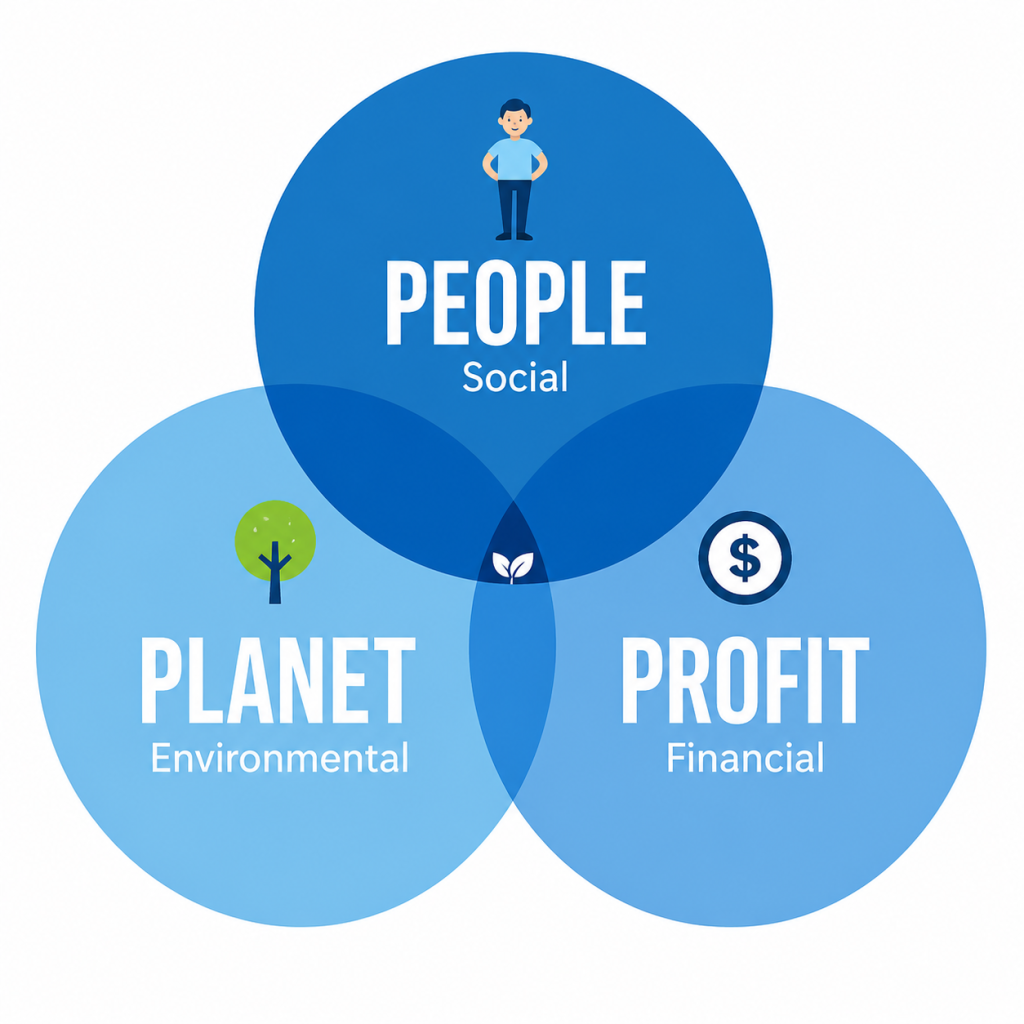
The central idea is straightforward: a successful company is not only one that generates strong financial returns, but also one that creates positive value for people and the planet. Today, the 3Ps Profit, People, and Planet remain one of the most widely used frameworks for explaining sustainability in practical and accessible terms.
Sustainability, ESG, and CSR: What Is the Difference?
These three terms are often used interchangeably, even though they serve different purposes.
Sustainability is the destination. It represents a long-term vision of how businesses can create value while safeguarding environmental, social, and economic resources for future generations.
ESG (Environmental, Social, and Governance) is the measurement framework. It consists of a set of indicators used by investors, regulators, and other stakeholders to evaluate how effectively a company manages environmental, social, and governance risks and opportunities.
CSR (Corporate Social Responsibility) is the action. It refers to the concrete programs and initiatives implemented by companies to fulfill their social responsibilities and create positive impacts for communities.
Rather than competing concepts, the three complement one another: sustainability provides the direction, ESG measures progress, and CSR translates the commitment into tangible actions that communities can see and experience.
The Connection to the SDGs
Since 2015, many sustainability strategies have been aligned with the United Nations Sustainable Development Goals (SDGs) 17 global goals designed to address challenges ranging from poverty eradication and quality education to gender equality and climate action.
Today, many organizations align their CSR initiatives with the SDGs so that their contributions can be measured against an internationally recognized framework rather than relying solely on internal corporate claims. This alignment also helps businesses demonstrate how their social and environmental initiatives contribute to broader global development priorities.
Why Sustainability Is More Than a Trend
What distinguishes genuine sustainability from greenwashing is consistency, transparency, and measurable impact. Companies that truly embrace sustainability typically:
- Publish sustainability reports regularly and transparently, rather than only when reputation management requires it.
- Engage key stakeholders including employees, local communities, and regulators in developing sustainability strategies, not merely during implementation.
- Integrate environmental and social considerations into core business decisions instead of treating them as separate philanthropic projects.
Sustainability is no longer just a corporate buzzword it is a strategic mindset that encourages companies to consider the long-term impact of every business decision on both people and the planet. This is where Corporate Social Responsibility (CSR) finds its true purpose: not as occasional charitable activities, but as an integral part of a broader commitment to sustainable development.