
Partner: PT PLN (Persero) Electricity Maintenance Center (Pusharlis)
Industry: Energy (Electricity)
Objectives
The “Electrifying Marine Fishermen of Pananjung Village” program, an initiative of PT PLN (Persero) Center for Electrical Power Maintenance (Pusharlis) as part of its Social and Environmental Responsibility (TJSL) efforts, aims to increase productivity and reduce operational costs for the Pananjung Village Fishermen’s Group in Pangandaran Regency. The program is implemented by converting fishermen’s boats from diesel-powered engines to battery-powered electric motors, equipped with cold storage facilities, charging stations, and clean energy education as part of an effort to accelerate a more environmentally friendly energy transition in the maritime sector.
Challenges
- Fishermen are the main drivers of the coastal economy, yet most still face limitations in transitioning to cleaner and more efficient energy sources. The main challenges addressed by this program are:
- High operational costs at sea due to reliance on petroleum-based fuel (BBM) are a burden on fishermen’s incomes.
- Exhaust emissions and noise from traditional boat engines impact marine ecosystems and pose an obstacle to Indonesia’s 2060 net-zero emissions target.
- Access to environmentally friendly technology and supporting infrastructure, such as charging stations and cold storage facilities to maintain the quality of the catch, remains limited.
- Fishermen’s ability to adapt to new innovations, particularly battery management, needs to be strengthened through mentoring and knowledge transfer.
Solution
PT PLN (Persero) Pusharlis, in collaboration with Filantra, launched this program on June 26, 2025, on the coast of Pananjung Village, Pangandaran Regency, West Java. The program runs from June 1 to November 30, 2025, with monitoring of program utilization continuing through mid-2026. The program integrates electric boat technology with supporting infrastructure and education.
- The electric boat conversion includes two sets of 8 kW, 96-volt BLDC motors complete with controllers, 72 V, 100 Ah LiFePO4 batteries with smart BMS, and wiring harnesses. A conventional 15 PK engine is provided as a backup propulsion system to ensure fishermen’s safety during the technology transition period.
- Charging stations: 3 sets of 25 A fast chargers (96 V) and 1 set of additional power supply at the fishing base to support battery charging and the operation of supporting facilities.
- Electric cold storage: 3 sets of cold storage facilities to maintain the freshness and market value of the catch, which are also used to produce ice cubes independently.
- Boat branding: 2 sets of “Electrifying Marine PLN Pusharlis” visual identity kits to identify boats developed under the PLN TJSL program.
- Outreach and education: On March 4, 2026, 10 fisherman representatives received training on the use of electric boats, operating procedures, safety aspects, as well as materials on green energy and the electrical lifestyle, concluding with pre- and post-tests.
- Conducting phased trials: The boats were tested in two phases to optimize performance and ease of operation, including the development of an “automatic” control concept (forward and reverse only) to make it easier for fishermen to adapt.
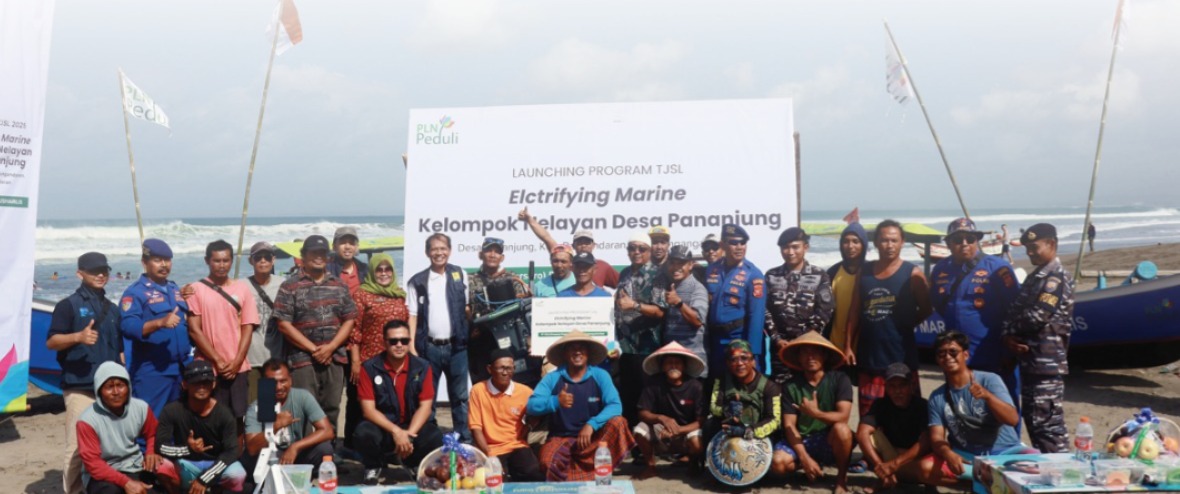
The launch was attended by PLN Pusharlis management, including representatives from the Senior Manager of Finance, Communications, and General Affairs, as well as the Manager of TJSL & KKU along with their teams, alongside Polairud, the Indonesian Navy (TNI AL), the Pangandaran Subdistrict Head, the Pananjung Village Head, the Chair of the Fishing Community, and the Chair of the Recreational Boating Association. The event included opening remarks, a symbolic handover of the converted boat and cold storage unit, and a demonstration of the electric boat.
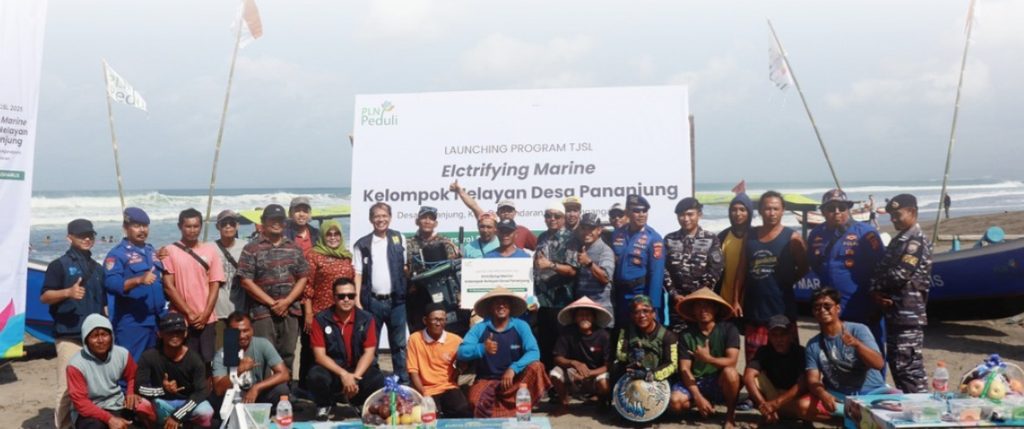
(Documentation of the “Electrifying Marine Fishermen of Pananjung Village” Program)
Impact
- This program helps the Pananjung Village fishermen’s group enter the era of electric-powered fishing, including:
- 13 fishermen from the Pananjung Village Fishermen’s Group received benefits from 9 types of assistance that were officially handed over.
- The electric boat proved operational: in the first test run, the boat reached a speed of approximately 15-20 km/h with 8 passengers on board in relatively calm seas, and in the second test run, traction performance improved with the motor reaching approximately 6,000 RPM. Notes on improvements from both test runs served as the basis for refining the system.
- The cold storage facility was used to store approximately 897 kg of seafood from July 2025 to March 2026, while also serving a dual purpose as a means of producing ice cubes, which began generating a positive net income from March to May 2026.
- The fishing group’s income increased from Rp2.48 million in July 2025 to Rp5.05 million in December 2025, although it remained volatile due to extreme weather and the fact that the fishing season had not yet begun.
- Education programs improved understanding of clean energy: participants’ average scores rose from 80 to 84.4, with three participants recording score increases of 10-20 points.
- The program evaluation led to follow-up measures, namely diversifying the use of cold storage, integrating marine weather forecast information into group management, and strengthening the groups’ institutional capacity so that the program can operate independently (self-sustaining).
Relevance to the SDGs
SDG 7: Affordable and Clean Energy
The program provides efficient and sustainable electric power solutions as a replacement for fossil fuels for the fishing fleet, complete with charging infrastructure at fishing harbors.
SDG 8: Decent Work and Economic Growth
By reducing dependence on fossil fuels and providing cold storage as well as business opportunities in the ice production sector, the program supports increased income margins and improved living standards for local fishermen.
SDG 13: Climate Action
The use of electric motors on fishing boats supports efforts to reduce exhaust emissions and the carbon footprint of the marine and fisheries sectors.
SDG 14: Life Below Water
Reduced noise pollution and the risk of oil spills from conventional engines help preserve underwater habitats and the sustainability of Pangandaran’s aquatic ecosystems.
Through this program, PT PLN (Persero)’s Electricity Maintenance Center, in collaboration with Filantra, is providing tangible support to fishermen in Pananjung Village, Pangandaran Regency, as part of efforts to create a greener, more efficient, and sustainable marine sector and to improve the well-being of coastal communities.