Desa Kutamaneuh’s Journey in Building Sustainable Waste Management with Coca-Cola Europacific Partners Indonesia and Filantra
Partner: PT Coca-Cola Europacific Partners Indonesia
Industry: Food and Beverage
Objective: This activity aims to increase the awareness and capacity of the Kutamaneuh Village community in managing household waste in a more structured, participatory, and sustainable manner. Through educational activities, training, and the provision of supporting facilities, the community is encouraged to be actively involved in waste sorting from the source (home) and to reuse materials that still have value through the application of the reduce, reuse, and recycle principles. This initiative, implemented through a collaboration between Coca-Cola Europacific Partners Indonesia and Filantra, is expected to support the creation of a cleaner, healthier environment, while also opening up opportunities to increase the community’s economic value through more productive waste management.
Challenges:
The implementation of the Household Waste Management Program in Kutamaneuh Village faced several challenges, including:
- The community’s habit of not being accustomed to sorting waste from the source at home.
- Still limited community understanding regarding sustainable waste management.
- Limited supporting facilities and infrastructure for household waste management.
- The need for continuous efforts to increase community awareness and participation in applying the principles of reduce, reuse, and recycle.
- The need to strengthen collaboration between the community and stakeholders, including Coca-Cola Europacific Partners Indonesia together with Filantra, to ensure the program can run consistently and sustainably.
Solution:
Based on the series of activities carried out in the Household Waste Management Program in Kutamaneuh Village, several solution steps were taken to address waste management issues at the community level as follows:
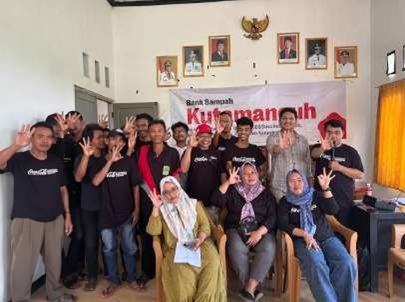
- Strengthening the institutional capacity of the Waste Bank (Bank Sampah) through waste bank management training and the provision of administrative systems such as ledgers and customer savings books to support more orderly and transparent management.
- Providing operational facilities and infrastructure through the construction of a waste bank operational warehouse and the provision of equipment such as scales, sorting sacks, office stationery, tables, chairs, and personal protective equipment for the management.
- Increasing community capacity in waste management through training on organic waste processing using the maggot method, composting, eco-enzymes, biopores, and the use of household composters.
- Increasing community awareness through socialization activities in several hamlets aimed at providing an understanding of waste types, waste sorting, and the difference between productive and non-productive waste.
- Developing organic waste processing through the provision of a maggot house facility as a means of processing household organic waste to reduce the volume of waste disposed of into the environment.
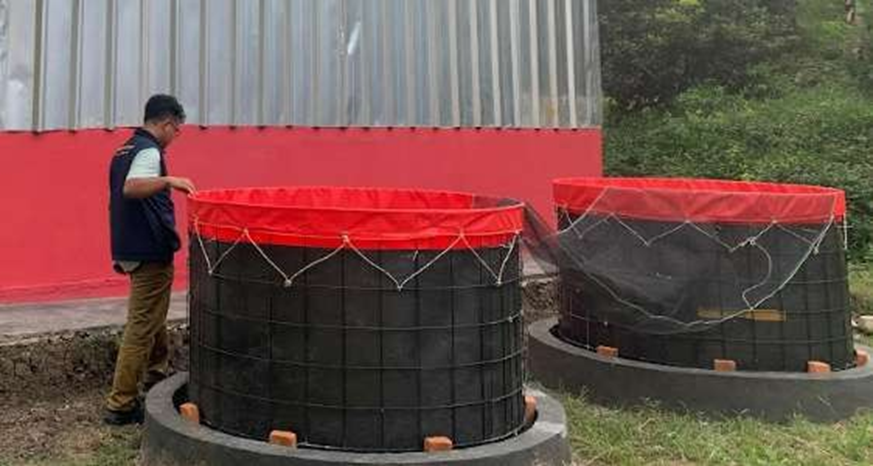
- Integrating environmental programs with productive economic activities through the provision of biofloc catfish ponds used as cultivation activities by the waste bank management.
- Providing operational assistance for the program through regular waste weighing activities and managing sorted waste products up to the sale stage to collectors.
Program Impact:
The implementation of this program provides various positive impacts for the community and the environment in Kutamaneuh Village. These impacts can be seen from several aspects:
- Community knowledge regarding household waste management increased through various training and socialization activities that have been carried out.
- The formation of a community-based waste management system through the operations of the Kutamaneuh Waste Bank as a vessel for waste management at the village level.
- Community awareness to sort waste began to increase following socialization regarding waste types and the utilization of waste with economic value.
- Waste that was previously disposed of directly into the environment is now being sorted, collected, and reused through waste bank activities and organic waste processing.
- The sale of sorted inorganic waste generated an initial income of Rp 818,750 for the operations of the Kutamaneuh Waste Bank.
- The biofloc catfish cultivation developed in this program produced an initial harvest of approximately ±10 kg with a cultivation period of about 2–3 months.
- Collaboration between the community, village government, and Coca-Cola Europacific Partners Indonesia was established in supporting more sustainable environmental management in Kutamaneuh Village.
SDGs Relevance:
The Household Waste Management Program in Kutamaneuh Village, supported by Coca-Cola Europacific Partners Indonesia, contributes to the achievement of several Sustainable Development Goals (SDGs). The program’s links to the SDGs goals are as follows:
- SDG 11 – Sustainable Cities and Communities This program supports the creation of a more sustainable residential environment through community-based waste management. Activities such as waste sorting socialization, waste bank operations, and organic waste processing help reduce the negative impact of household waste on the residential environment.
- SDG 12 – Responsible Consumption and Production This program encourages the community to adopt more responsible consumption and waste management patterns. Through waste sorting activities, the sale of inorganic waste, and organic waste processing using the maggot method, the community is encouraged to reuse waste that has functional and economic value.
- SDG 13 – Climate Action Better waste management contributes to reducing environmental pollution and potential emissions generated from waste accumulation. Through organic waste processing and reducing waste disposed of into the environment, this program also supports local climate change mitigation efforts.
Strengthening Environmental Management, Driving Community Independence
Through the Household Waste Management Program in Kutamaneuh Village, Karawang Regency, various initiatives were carried out to increase community awareness and capacity in managing waste sustainably. This program was realized through the formation and strengthening of Waste Banks, the construction of operational warehouses, the provision of supporting infrastructure, and the implementation of various socialization and training activities for the community regarding waste sorting and processing.
Furthermore, the program also encourages the utilization of organic waste through maggot cultivation and the development of productive economic activities such as biofloc catfish farming. These efforts not only contribute to reducing household waste generation but also open up economic value opportunities for the community through more structured waste management.
Together with Filantra, various social and environmental initiatives can continue to be expanded through impactful collaborations. Let’s collaborate with Filantra to deliver more sustainable community empowerment programs and create a real impact on the environment and community welfare.